Registration now open!
📅Starts Tuesday, November 4th — 7:00–8:30 PM EST
💻 Live, interactive Zoom workshop & roundtable
Join us for a 90-minute session designed for caregivers like you.
Every time your parent or loved one calls, your chest tightens — even before you pick up.
People mean well, but they don't always understand. Someone once asked me,
"Why do you need so much time to take care of your parents?
Aren't they already in assisted living? "
What they don't see is the invisible labor that never ends — the decisions, the worry,
the managing, the guilt.
The emotional load of caregiving stretches far beyond logistics.
You know this kind of weight:
Most people think caregiving follows a predictable path — you start helping, things get harder, and eventually, you adjust.
But anyone who’s lived it knows that caregiving doesn’t move in a straight line.
You can be years into caregiving and still feel like everything is a challenge.
You can find your rhythm one month and lose it the next.
You can hold deep love for the person you care for and still feel resentment, guilt, or exhaustion.
None of that means you’re doing it wrong. It means you’re human.
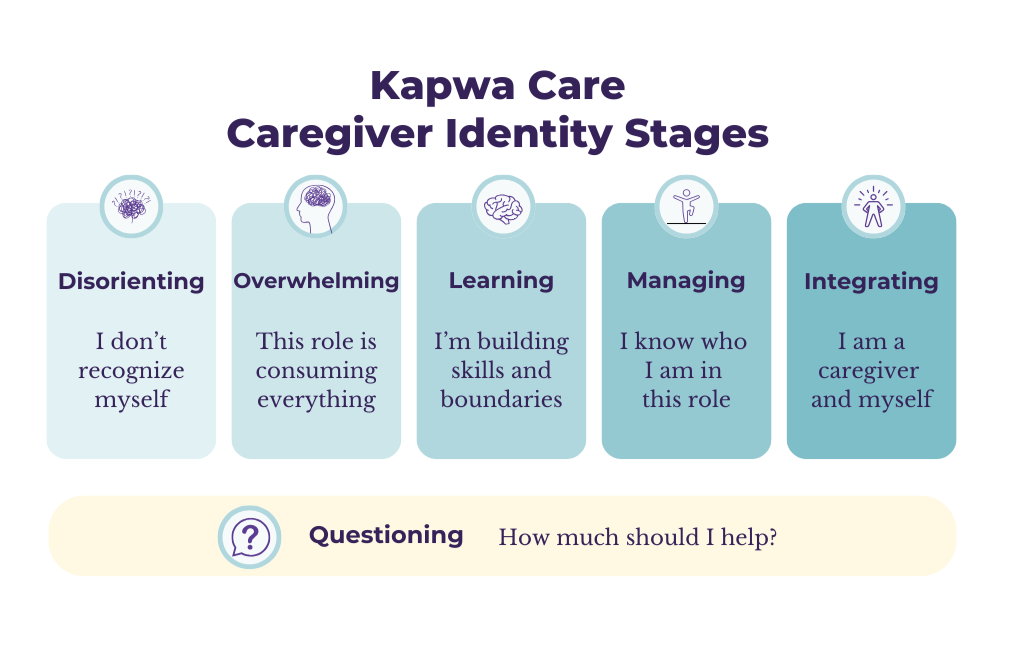
That’s because caregiving isn’t just about logistics — it’s an identity journey.
How you see yourself, your loved one, and your role changes over time.
And if you never take the time to understand or own that identity, you can get stuck in the same emotional cycles — no matter how long you’ve been caregiving.
That’s what the Caregiver Identity Journey framework is here to change.
It helps you recognize where you are, what you’re learning, and how to move forward with more clarity and compassion.
Because how do you find your way forward if you don’t even know there is a roadmap?
Most caregivers think they’re lost — when really, no one ever told them there’s a path.
Because every journey needs a roadmap.

Knowing where you are and where you want to go is powerful — but integration takes practice and structure.
The Caregiver Identity Intensive gives you a way to
move through the stages with focus and flow, instead of fatigue and guesswork

Change doesn't happen from
knowing more — it happens
from practicing differently

These reflections come from our first Caregiver Identity Workshop — the experience that inspired the Intensive
Q: What if I can’t make a session?
A: You’ll receive recordings to watch anytime.
Q: Is this only for adult children caring for parents?
A: No — it’s for anyone providing care to family, friends, or community, who feels the weight of identity shift.
Q: What if I’m not sure I’m even a caregiver?
A: That’s okay. We start by helping you name it — and move forward from there.
Caregiving doesn’t mean losing yourself. It can be integrated,
honored, and even joyful.
Join me for the Caregiver Identity Intensive — let’s walk this path together.

Grace Macalino Schauf, PhD, MPH, is a public health scientist whose research has focused on HIV and the social determinants of health. She brings that expertise to being a caregiver advocate, shaped by her personal journey as a sandwich generation caregiver, After losing her sister-in-law unexpectedly, Grace pivoted from traditional public health work to focus on the 53 million Americans providing unpaid family care.
Grace developed the Caregiver Identity Framework through her own experience caring for aging parents while launching teen children - navigating multiple caregiver identity transitions simultaneously. She knows firsthand the whiplash of celebrating growth and managing decline, sometimes in the same day.
Her approach combines evidence-based tools with lived experience—meeting the realities of complex family dynamics, cultural expectations, and the emotional challenge of caring for someone while staying yourself.
You don't have to navigate caregiving alone.
Start your roadmap to balance today.